


Container and site box door monitoring
Your container was opened at 2:14 on Sunday morning. You found out Monday.
One sealed unit on the door. No wiring, no site power, no site network. When the door swings, your phone rings.
Request a quote Call 1300 150 361
Nothing to wire in
Bolts to the outside of the door and runs on its own battery. No mains, no cabling, no electrician, no holes cut through the container.
Two signals, not one
The unit senses its own movement and measures its distance to a fixed target. Both have to agree before it alarms — so a knock, a gust or a passing truck doesn't wake anybody.
Australian owned and supported
Over 4,000 monitored devices across water, gas, rail and industrial sites, supported in your time zone.
Know the moment a door opens — not the next morning
A padlock records nothing. A camera records everything and tells you nothing until someone sits down and reviews it. Neither one wakes anybody up.
Most losses from containers and site boxes are not sophisticated. Someone cuts a lock on a Saturday night in an empty yard, loads a ute, and drives away. The theft takes eleven minutes. The discovery takes thirty-six hours. By then the tools are gone, the job is stalled, and the insurer wants to know exactly when it happened.
A DataCell door sensor closes that gap to seconds.
How it works
1. The sensor. A single sealed unit mounts to the outside of the door leaf, facing a fixed target on the door frame or adjacent structure. Nothing is fitted inside the container, so nothing has to be moved when the container is loaded.
2. Two independent confirmations. When the door swings, the unit detects its own motion, and the measured distance to the fixed target changes at the same instant. It reports an opening when both agree. That is the difference between a real alarm and a nuisance alert.
3. The network. Cellular, direct from the sensor. No gateway, no site Wi-Fi, no fixed IP address, nothing for an IT department to approve. Because the unit sits on the outside of the container, it is not transmitting from inside a steel box.
4. The alert. SMS, email, or both, to as many recipients as you need. Every open and close is timestamped and retained, so you have the audit trail as well as the alarm.
Escalation is configurable — an out-of-hours opening can go to the site supervisor first, then to the manager if it is not acknowledged.
The hardware
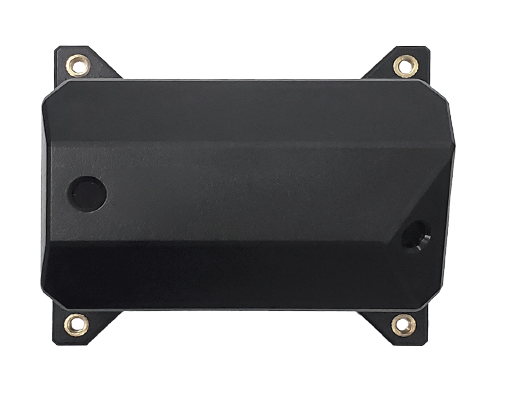
| Dimensions | 102 × 86 × 48 mm |
| Weight | 238 g |
| Housing | ABS + PC, one-piece sealed |
| Ingress protection | IP68 |
| Operating temperature | −15 °C to +60 °C |
| Wireless | NB-IoT (LoRaWAN option) |
| Battery | 19,000 mAh lithium, up to 5 years at typical door usage |
| Mounting | Screw-fix or magnetic bracket |
Why two signals matter
Single-sensor door monitors generate false alarms, and false alarms get switched off. Within a month of nuisance trips, nobody is reading them.
A magnetic contact fires when the door flexes in the wind. A tilt sensor fires when someone leans a sheet of ply against the container. A single distance reading can be defeated by covering the lens.
This unit cross-checks. Movement without a distance change is vibration, and it is logged rather than alarmed. A distance change without movement is something obstructing the sensor — which raises a fault, not silence. Only genuine door travel produces both at once.
The result is an alert people still trust in month six.
Real-time visibility across every container, anywhere
Door events are captured the moment they happen and delivered to the DataScape platform, giving you:
- Live open or closed status for every container, box and store
- Immediate alerts on any opening outside approved hours
- Complete timestamped history for insurance, audit and dispute resolution
- 24/7 oversight from your phone, tablet or desktop
- One view across every site, whether you run three containers or three hundred
Whether the asset sits in a depot, on a construction site, in a laydown yard or on a farm, the information reaches you the same way.
What can be monitored
- Door open and door closed, with timestamp on every event
- Duration the door stayed open
- Number of open and close cycles over a period
- Openings outside approved hours or outside a rostered window
- Impact and movement events on the door itself
- Sensor removal or tampering
- Obstruction of the sensor, reported as a fault rather than going quiet
- Sensor battery status, so you are warned before it goes flat
Where it goes
- Shipping containers on construction and civil sites
- Site boxes and tool cages on multi-trade jobs
- Remote depots and laydown yards with no permanent staff
- Chemical, fuel and dangerous goods stores where access has to be documented
- Council and utility storage at unmanned sites
- Farm sheds, chemical stores and workshops on properties with no network at the shed
- Switchrooms, cabinets and pump station kiosks where an open door is the first sign of interference
"We already have a lock."
A lock is a delay, not a notification. It tells the thief how long they have. It tells you nothing at all.
The question is not whether the container is locked. It is what happens between knock-off on Friday and start on Monday, and whether you find out inside that window or after it.
Reduce theft, loss and downtime
Tool and plant theft from construction sites costs Australian builders and contractors heavily every year, and the value of the stolen gear is usually the smaller half of the bill.
With DataCell and DataScape, businesses commonly benefit from:
- Immediate response to an out-of-hours opening, while the offender is still on site
- Faster police reporting with a precise, verifiable timestamp
- Stronger insurance claims backed by an independent event log
- Reduced downtime — crews are not stood down waiting on replacement gear
- Fewer speculative drive-bys and security patrols
Not sure how it would mount on your containers?
Send us a photo of the doors and locking bars and we will tell you.
Prove who had access, and when
Where access has to be controlled — dangerous goods stores, quarantined materials, secure equipment, chemical sheds — a door log is the evidence.
DataScape's timestamped records make it simple to:
- Demonstrate that a store was closed and secured outside approved hours
- Confirm access times against contractor and delivery records
- Provide audit-ready data to regulators, insurers or head contractors
- Resolve disputes about when something went missing
Accurate, verifiable, and accessible from anywhere.
Common questions
How many sensors does a container need?
One. On a standard twin-door container the leading leaf has to open first — the trailing leaf is physically captured behind it. Monitor the leading leaf and you have covered every way in through the doors.
Does the site need power?
No. The unit runs on its own internal battery for up to 5 years at typical door usage.
Does the site need internet or Wi-Fi?
No. Each unit has its own cellular connection.
Will it work on a steel container?
Yes. The unit mounts on the outside, so it is not trying to transmit from inside a sealed steel box — which is where most container monitoring falls over.
How is it fixed on?
Screw-fix or magnetic bracket options are available.
Will it survive outdoors?
The housing is IP68 rated, sealed against water jets and dust, and built for permanent outdoor mounting. Rated for operation from −15 °C to +60 °C.
Can I move it to another container?
Yes. When the job finishes, the unit moves with the container or onto the next one.
What about legitimate access during work hours?
Alert rules follow a schedule. Openings during approved hours are logged silently; openings outside those hours raise an alarm. You can also mute alerts for a delivery window without losing the log.
What if someone covers or knocks the sensor?
Both are detected. Covering it changes the distance reading without any matching movement, which raises a fault. Knocking or removing the unit raises a tamper alert. It does not fail silently.
Does it tell me who opened the door?
It tells you exactly when, and for how long. Combined with your site access records or camera footage, that timestamp is usually what identifies who.
Who installs it?
Anyone on your team. There is no wiring and no electrical work. We configure the alerts before it ships.
Protect your gear, your program, and your people
DataCell and DataScape turn a locked door into a monitored one. Every opening is confirmed two ways, timestamped and delivered immediately — so the people who need to know find out on the night, not on Monday morning.
Less theft. Less downtime. Better evidence. Fewer surprises.
Find out what it would cost for your sites
Tell us how many containers, boxes or stores you need covered and we'll come back within one business day.